Tapping away

The summer after 7th grade, my mother signed me up for a touch-typing course. I don’t think I saw the point of it at the time, but I didn’t have anything better to do. Every morning for a couple of weeks I sat in front of a machine, memorizing the QWERTY keyboard and tapping out variations on The quick red fox jumped over the lazy brown dog.
I turned out to be good at it, quick and accurate, which gave me a pleasant sense of competence (unlike every PE class I took). But I had no idea how useful touch-typing would turn out to be, or that I would be using the skill all these long years later. It’s moved with me from machine to machine to machine, through the great analog-to-digital shift. It’s still the human touch that powers my work.
I don’t remember when I got my first electric typewriter—probably not long after I took the typing class. By the time I got to college, the Olympia Report de Luxe had become my ride or die, my secret weapon, my companion in the lonely watches of the night before a class assignment or a story for the Daily Princetonian was due.


Time and technology marched on. In my senior year, thanks to a student deal, I got my first computer, a boxy little first-gen Macintosh. It got me through my senior thesis, though it also went wonky on me THE NIGHT BEFORE THE DEADLINE. User error, maybe, and anyway by then I was well acquainted enough with the perils of brinksmanship to know the risks of delay—not that that has ever stopped me from working on a big project up until the final hours.
I don’t remember what became of that little Mac, superseded by newer desktop models and then by a series of laptops, including the Mac Air I’m typing this on. I unearthed the Olympia not long ago in the basement tool room during one of those periodic reassessments of accumulated stuff I have decided to call Swedish Life Cleaning, not being quite ready to embrace the idea of death cleaning yet.
I hauled the typewriter out, thinking it would be fun to take it for a spin. The weight of it—27 lbs. in its case—startled me. I hadn’t remembered its being such a beast. I lugged it upstairs and set it up on the dining room table. I rethreaded and rewound the ribbon, which had gone slack. I rolled in a fresh sheet of paper, plugged the machine in, and switched it on.
Ah, that expectant hum, as familiar to me as the QWERTY keyboard. I indulged a fleeting fantasy that I would give the Olympia one last hurrah and pound out some fiction on it this summer in a burst of analog creative expression. No internet, no distractions between me and the blank page.
Then I discovered that the Olympia’s carriage return no longer advances the paper a line. Talk about friction-maxxing. I’m sure it’s an easy fix, and there’s a good typewriter repair shop in the DMV, but I realized I’m past the point of wanting to use the machine at all. It’s heavy. It’s loud, though not as thunderous as the Brother electric typewriter that I also unearthed and brought upstairs for a test run. I don’t miss fingertip smudges from messing with typewriter ribbons. I don’t miss Wite-Out and that powdery correction tape. I’ve gone soft. The quiet and portability of the laptop have won me over.
The Olympia and I had a good run. We’ll always have Paris (or Princeton). Thanks to one of my beloved neighborhood giveaway groups, it’s been passed on to someone not even half my age, who told me she’s always wanted to try a typewriter. The Brother’s been passed on to another local Gen Zer. Bless the young and their curiosity about the old ways.
That just leaves three (how did this happen??) manual typewriters in the basement to deal with. Either they’ll spark my personal analog renaissance or they’ll find new, likely much younger typists to set them clackity-clacking again. As long as I have a QWERTY keyboard I’ll manage.
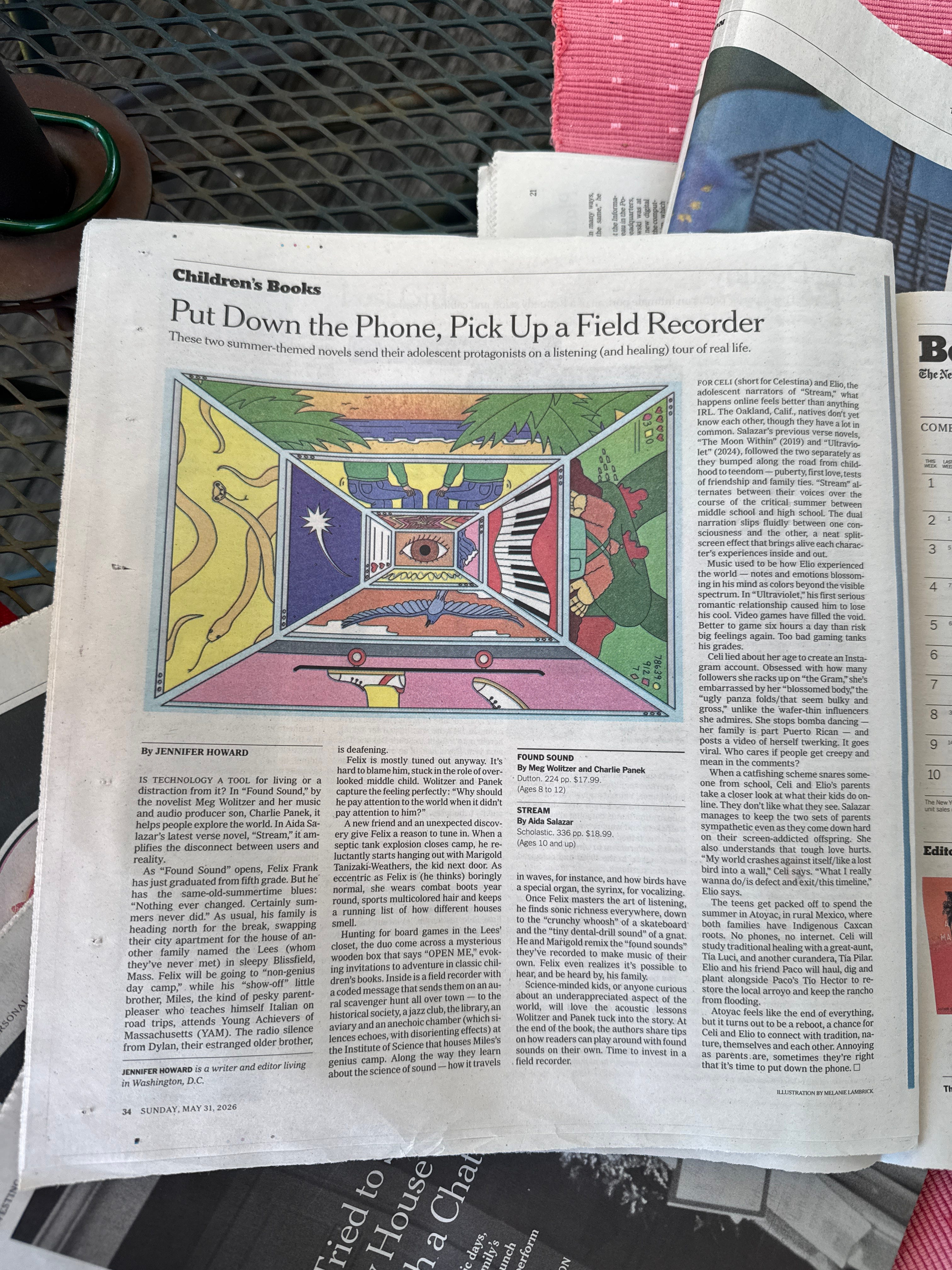
New writing: One analog pleasure I’ll never get tired of: seeing something I wrote (on whatever device) in print. My latest review for the New York Times Book Review ran in the May 31, 2026 print issue, and of course you can find it online.
“Is technology a tool for living or a distraction from it? In “Found Sound,” by the novelist Meg Wolitzer and her music and audio producer son, Charlie Panek, it helps people explore the world. In Aida Salazar’s latest verse novel, “Stream,” it amplifies the disconnect between users and reality.”
Both books deal, in strikingly different ways, with how technology connects and disconnects people, and neither was a waste of my reading time.
New and forthcoming books I’m stoked about:
Everything She Most Admired: A Mystery Novel by Deborah Kalb (Apprentice House, May 5, 2026). Deborah and I went to elementary school together, so of course I had to pick up a copy of her new novel—especially because it’s set in DC, at the kind of magazine that was already a dying breed in 2017, the year the book is set. Here’s the premise:
Lauren Green never expected to be a suspect in a murder investigation on her first day at D.C.-based Lens magazine. But then again, nothing had been going well lately.
Dumped by her fiancé, her academic career floundering, and her living situation up in the air, she’s barely holding things together. She knows she didn’t kill reporter Tony Mandel. But who did? Surrounded by murder suspects-including one whom she finds surprisingly intriguing-Lauren tries to piece the clues together, not only about Tony Mandel’s death but also about her own life.
Since 2012, Deborah has also done a lovely series of Book Q&As with authors (including me, when Clutter: An Untidy History came out). Also check out “Rereading Our Childhood,” the podcast she does with Mary Grace McGeehan. Being the same vintage, Deborah and I read a lot of the same books, and it’s been fun to revisit them via the podcast.
American Made: Stories of Work from the WPA, edited by Anne Trubek (Belt Publishing, forthcoming July 14, 2026). My friend and publisher Anne T. has pulled together a fascinating collection of American workers’ stories from the American Life Histories project, recorded in the 1930s by the writer-interviewers (including Ralph Ellison!) of the New Deal’s Works Progress Administration. The archive is housed at the Library of Congress, just down the street from me. I got hold of an advance copy of the book, and it’s truly fascinating. Publishers Weekly calls American Made “a mesmerizing combination of voices for this captivating compendium. Meat-packers, steelworkers, telegraph operators, domestics, and musicians offer digressive, at times wonderfully odd stories about their working lives.” I love that it’s coming out on Bastille Day, which feels appropriately revolutionary.
Three Tenses: A Transmission from the Nineties, by Ed Park (Penguin Random House, forthcoming Aug. 11, 2026). A writer’s memoir-in-fragments, written when the author was 28 years old—a sign of great things to come.
Publishers Weekly gave it a starred review: “Stray musings and recollections reveal a writer’s restless mind in this scintillating memoir from novelist Park (An Oral History of Atlantis).…Writers are often better at thinking thoughts than doing deeds, and Park wisely downplays narrative arc in favor of stray ruminations and insights that coalesce to illuminate his endlessly curious, mordantly funny worldview.” I love Ed’s sensibility, so I am truly looking forward to this. And if you pre-order from Yu & Me Books, Ed will personalize a signed copy for you.
What books are you reading/looking forward to this summer? And if you still use a typewriter, let me know about it in the comments.
Cheers,
Jen